From Monolith to Microservices: How Bounded Context Improves AI-Driven Development

Introduction
When we first launched our vibe coding platform, the architecture started as a single monolithic application. Initially this approach allowed us to move quickly and ship features fast.
But as the platform grew, the warning signs appeared.
The codebase became increasingly complex, new features were harder to implement, and development velocity began to slow down. What once felt manageable started to evolve into a tightly coupled system that was difficult to reason about.
To solve this, we made a strategic decision: refactor the platform from a monolith into a microservices architecture.
In this article we explain:
- Why monolithic architectures struggle in AI-driven systems
- How Domain-Driven Design (DDD) helps define system boundaries
- Why bounded contexts are critical for AI agents
- How we split our platform into eight microservices
This architectural shift significantly improved both developer productivity and AI agent performance.
Understanding Domain-Driven Design
The Origins of Domain-Driven Design
The concept of Domain-Driven Design (DDD) was introduced by Eric Evans in the influential book Domain‑Driven Design: Tackling Complexity in the Heart of Software.
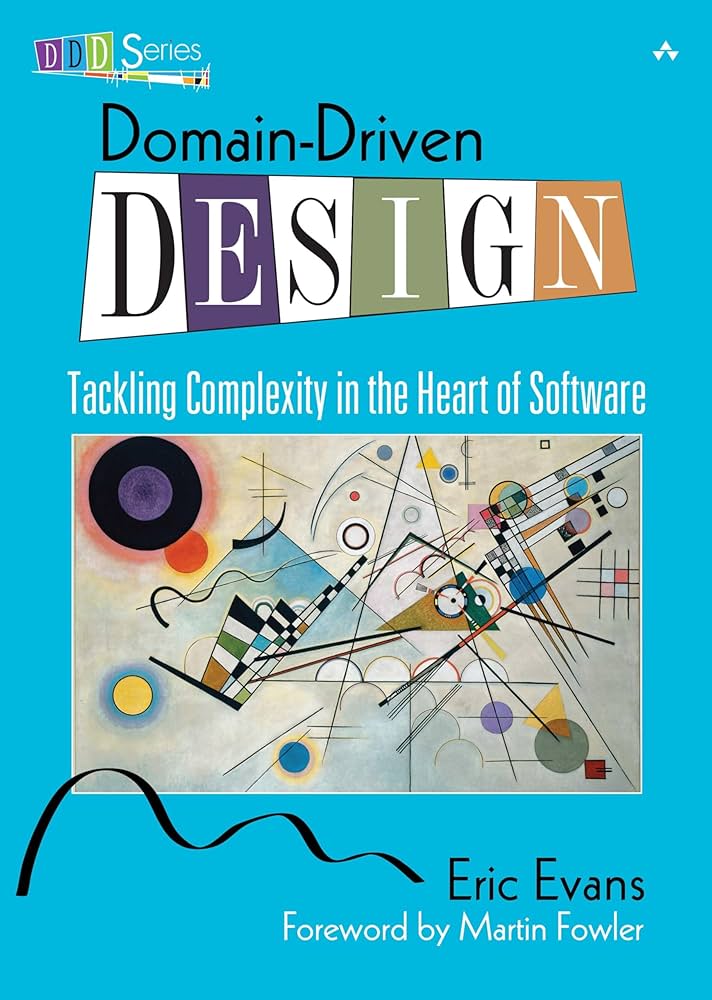
Although the book was published in 2003, its ideas remain extremely relevant today. Many modern architectural patterns—including microservices—are heavily inspired by DDD principles.
DDD focuses on one core idea:
Software architecture should mirror the structure of the business domain.
Instead of organizing systems purely around technical layers, DDD encourages teams to structure software around real business capabilities and concepts.
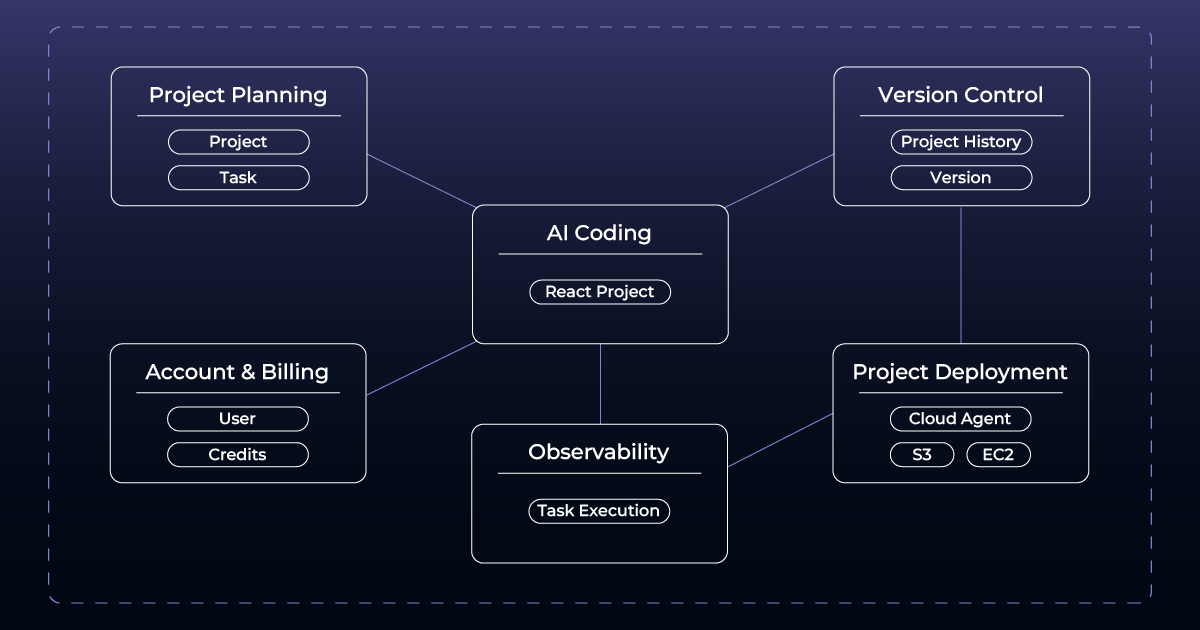
While doing domain distillation, we detected the 6 main bounded contexts that can act as independent services: project planning, AI coding, project deployment, version control, observability, account and billing.
The Monolith vs Microservices Debate
For years developers have debated a fundamental architectural question:
Should applications remain monolithic, or should they be broken into microservices?
Monoliths have advantages:
- Simpler deployments
- Easier early development
- Fewer distributed systems challenges
However, as systems scale, monoliths often become harder to maintain. Large codebases accumulate complexity and eventually turn into what developers often call a "Big Ball of Mud."
Today the conversation has evolved even further.
We are no longer building systems only for human developers.
We are building systems that AI agents interact with, modify, and reason about.
And this introduces a new challenge.
Why Monolithic Architectures Confuse AI Agents
AI agents rely heavily on clear context boundaries.
When a system grows into a large monolithic repository:
- Domain concepts overlap
- Terminology becomes ambiguous
- Architectural boundaries blur
This makes it harder for AI systems to correctly interpret intent.
For example, an AI agent might receive a command such as:
"Create a project."
In a large monolith, the term project might refer to several different things:
- A planning workspace
- A source code repository
- A deployment environment
Without clear boundaries, the AI agent must guess the meaning.
And guessing leads to errors.
This is why architectural clarity matters even more in AI-driven development environments.
What Is a Bounded Context?
Defining Bounded Context
A Bounded Context is a central concept in Domain-Driven Design.
It defines a clear boundary within which a specific domain model applies and terminology has a single meaning.
Inside a bounded context:
- Language is consistent
- Concepts are clearly defined
- Domain logic belongs only to that context
This creates a shared understanding between:
- Developers
- Domain experts
- AI agents
Each context effectively becomes its own mini-world with well-defined rules.
Why Bounded Contexts Improve AI Development
In large software systems, the same word can mean different things in different domains.
While building our AI coding platform, we encountered this problem quickly.
Consider the word project.
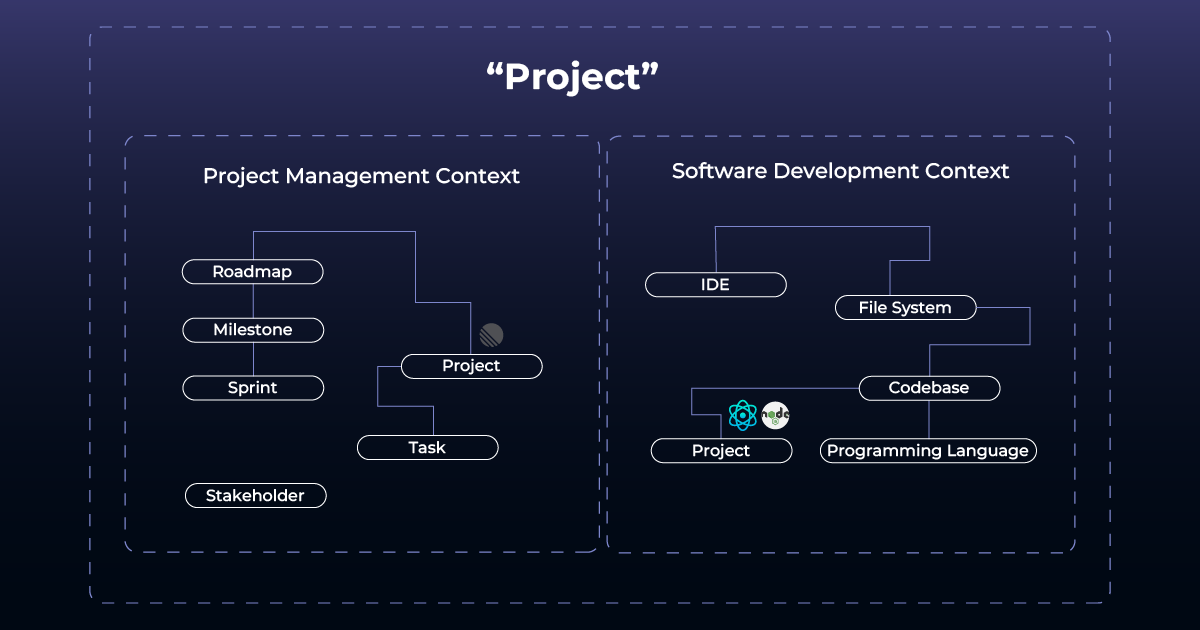
When both meanings existed in the same codebase, confusion spread.
Not only for engineers—but for AI agents operating within the platform.
By introducing bounded contexts, we ensured that each domain defines its own terminology and behavior.
This dramatically improved the reliability of both human workflows and AI-generated development tasks.
Our Microservices Architecture
After refactoring the platform using Domain-Driven Design principles, we divided the system into eight bounded contexts, each implemented as a separate microservice.

This allowed each domain to evolve independently while maintaining clear system boundaries.
1. Project Planning Context
The Project Planning Context manages planning activities.
Within this domain we store:
- Tasks
- Planning artifacts
- Project structures
- Coordination workflows between users and AI agents
This context is primarily used by product managers and planning agents.
2. AI Coding Context
The AI Coding Context is where development actually happens.
AI coding agents operate in this domain and perform tasks such as:
- Writing code
- Modifying repositories
- Committing changes
- Managing development workflows
In many ways, this context behaves similarly to a development environment used by human engineers.
3. Project Deployment Context
The Project Deployment Context manages the infrastructure and pipelines required to deploy software built by AI agents.
Responsibilities include:
- CI/CD pipelines
- Deployment workflows
- Environment configuration
- Build orchestration
This context is most familiar to DevOps engineers.
4. Version Control Context
While platforms like GitHub provide robust version control, we chose to build a lightweight internal system optimized specifically for AI-driven development workflows.
This system allows agents to interact with repositories in a more controlled and structured way.
5. Observability Context
The Observability Context collects events and analytics from across the platform.
This includes:
- Agent behavior
- Development events
- System performance metrics
Observability helps us understand how AI agents build software and where improvements are needed.
6. Account and Billing Context
The Account and Billing Context manages:
- User accounts
- Platform credits
- Usage tracking
- Payments and subscriptions
This domain ensures that platform access and billing are handled securely and transparently.
7. API Gateway
The API Gateway acts as the central entry point into the platform.
It is responsible for:
- Authentication
- Authorization
- Security enforcement
- API routing between services
This layer simplifies communication between clients and internal services.
8. Platform UI
Finally, the Platform UI provides the user interface that connects all services together.
Through the UI, users interact with:
- Planning workflows
- AI coding agents
- Deployment pipelines
- Observability dashboards
The UI communicates with backend services through the API layer.
Avoiding the Big Ball of Mud
Without clear architectural boundaries, complex systems eventually degrade into tightly coupled codebases that are difficult to maintain.
Developers often describe this situation as a "Big Ball of Mud."
Symptoms typically include:
- Spaghetti code
- Increasing bugs
- Slower development cycles
- Poor onboarding experience
- Confusing system behavior
For AI-driven platforms, the consequences are even worse because agents lose the contextual clarity required to generate reliable code.
By organizing our platform around bounded contexts and microservices, we achieved several key benefits:
- Clear domain ownership
- Faster feature development
- Better system scalability
- Improved AI agent performance
- More maintainable architecture
Final Thoughts
As AI agents become increasingly involved in software development, architecture design must evolve alongside them.
Bounded contexts and microservices are no longer just about scaling engineering teams—they also help AI systems reason about complex software platforms.
For us, adopting Domain-Driven Design and microservices architecture transformed a growing monolith into a scalable platform designed for the future of AI-assisted development.

With tools and technology we already have, we can build much more valuable systems than most projects today. We can write software that is a pleasure to use and a pleasure to work on; software that doesn't box us in as it grows, but creates new opportunities and continues to add value for its owners.