Structure Shapes Success

Introduction: The Power of Structure
What if the secret to building great products isn't just about the right tools, but the way you organize your team? Whether it's a company designing cutting-edge software, an automaker revolutionizing transportation, or a colony of bees constructing a hive, the structure of the team determines the outcome of what gets built.
In software development, one of the most overlooked but powerful forces shaping a product is Conway's Law — the principle that the design of a system mirrors the communication structure of the team that created it. In other words, if your teams are fragmented, your product will feel fragmented. If your teams work in harmony, your product will feel cohesive.
But this principle doesn't just apply to software — it's a universal truth that governs how things are built across industries, even in nature. Nowhere is this more apparent than in the world of bees. Their instinctive use of hexagonal structures provides a masterclass in efficiency, adaptability, and intelligent design. And just as bees build their hives in a way that maximizes their efficiency, companies — and now even AI-driven teams — can structure themselves to optimize for success.
Bees and Hexagonal Structures: Nature's Lesson
Bees don't just build randomly — they follow a precise structure, using hexagons to form the foundation of their hive. This isn't by accident. The hexagon is the most efficient shape in nature, requiring the least amount of material while maximizing storage space. It allows for easy scalability and ensures that each bee can contribute effectively to the colony's survival.
This principle of structured collaboration is key in any complex system. Whether it's a beehive, a city, or an AI-driven software team, efficiency and adaptability depend on how well the underlying structure supports growth and communication.
In software development, the hexagonal architecture model takes this idea further. Hexagonal architecture, also known as the ports and adapters pattern, creates a modular, scalable system where components interact through well-defined interfaces.
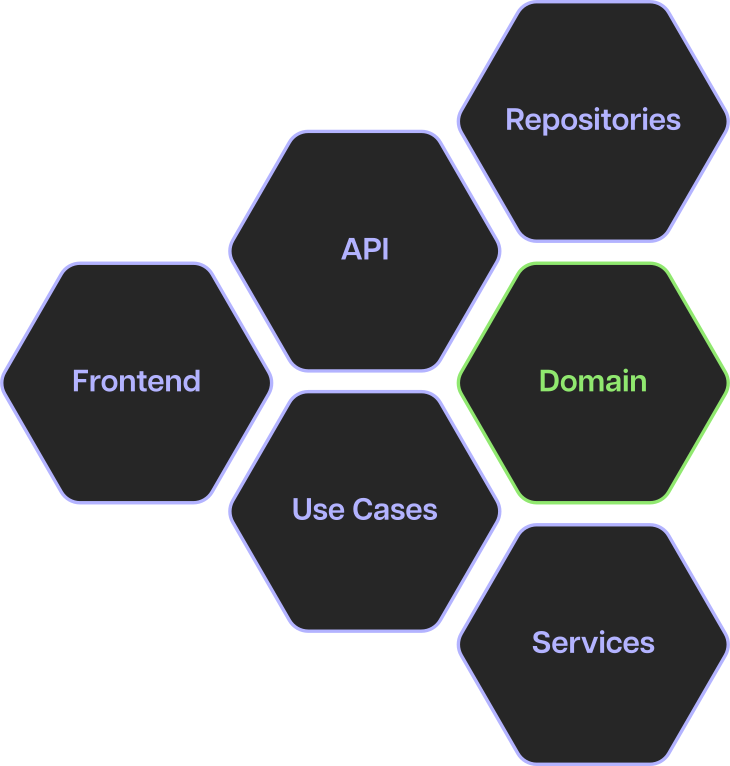
Just like in a beehive, where each hexagonal cell fits perfectly into the larger structure, software built on hexagonal architecture allows teams to replace or upgrade components without disrupting the entire system. This adaptability is critical in fast-moving industries, where innovation and iteration are key to staying ahead.
Conway's Law: The Link Between Structure and Success
Melvin Conway's insight — now widely recognized as Conway's Law — states that any system will reflect the structure of the teams that built it. If an organization has siloed departments that rarely communicate, the product they build will likely have disjointed features and integration problems. Conversely, if a company has cross-functional teams that collaborate closely, the end product will feel seamless and well-integrated.
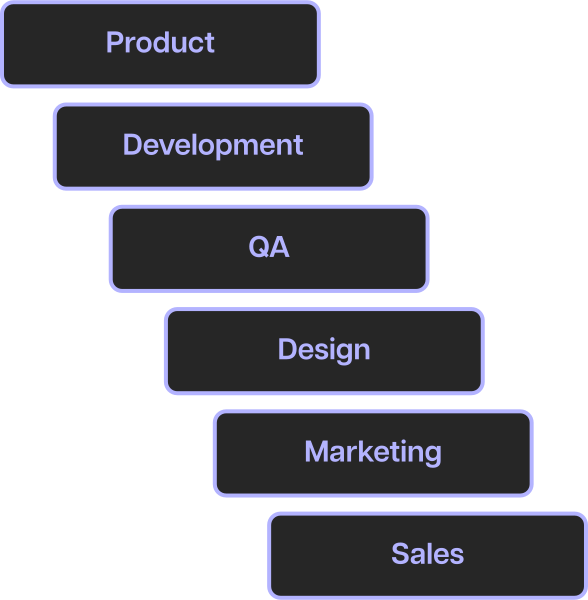
Product is so far away from the market, which causes teams to build stuff no one wants—a hallmark of the waterfall model.
Real-World Examples of Conway's Law
Tesla vs. GM
Software Integration
Tesla's tightly integrated teams work on software and hardware in parallel, creating a car where the software feels like an extension of the machine.
GM historically had more fragmented teams, leading to cars with disjointed infotainment systems that didn't fully integrate with the driving experience.
Interactive Illustrations
Click on each example below to see an animated visualization of their team structures and system architectures.
Tesla's Integrated Systems
A visualization of Tesla's tightly integrated software and hardware components working in harmony.
Marvel's Connected Universe
An interconnected web showing how Marvel's storylines and characters form a cohesive narrative universe.
AWS Microservices
A hexagonal grid representing AWS's modular microservices architecture.
Tesla's Integrated Systems
A visualization of Tesla's tightly integrated software and hardware components working in harmony.
The lesson? If you don't intentionally design your teams, your product will inherit their inefficiencies.
Applying Conway's Law to AI Teams
With the rise of AI-driven development, we now have the opportunity to structure not just human teams, but AI teams that mirror the needs of their users. At JigJoy, we are building a platform that allows users to build AI agent teams that function like human teams, structured in a way that optimizes for their specific goals.
This is where hexagonal architecture comes into play. Just like the bees' hive, our platform enables modular, adaptable team structures that scale efficiently. Users can configure AI agents into specialized teams, ensuring that the software they generate aligns perfectly with their vision. Each AI agent operates within a well-defined role, connected through clear interfaces, making it easy to adapt and evolve without disrupting the entire system. This mirrors the AWS microservices approach — where each unit operates autonomously but communicates effectively with the whole.
Try it yourself!
Experience how modular AI teams work together by assembling your own team of specialized agents. Drag and drop the agents to create a cohesive team that can tackle complex tasks.
Build a Feature
Click to add agents to your team
Available AI Agents
Planning Agent
Designs the overall strategy and coordinates other agents
Research Agent
Gathers and analyzes relevant information
Execution Agent
Implements the planned solutions
Select agents to add them to your team
Team structure = product structure. This principle applies in every industry, from nature to software development to AI-driven automation. The way you design your teams, whether human or AI, will shape the outcomes you achieve.
The next time you set out to build something, whether it's an app, a business, or a revolutionary new product, don't just ask what you want to create. Ask how your team is structured to make it happen. Because in the end, structure isn't just a byproduct of what you build — it's the foundation that determines what's possible.

With tools and technology we already have, we can build much more valuable systems than most projects today. We can write software that is a pleasure to use and a pleasure to work on; software that doesn't box us in as it grows, but creates new opportunities and continues to add value for its owners.