How Radical Technologies Create New Markets

The Evolution of New Markets by Paul Geroski is one of my favorite books.
Through historical examples such as cars, television, and the internet, Geroski explains how new markets are created, how they evolve, and why new categories often emerge from the technology side rather than from clearly expressed market demand.
Inchoate demand
When a radical technology such as AI enters the market, customer demand is often inchoate.
People do not yet fully understand what the technology can do, what is now possible, or what they should even ask for. They can describe their existing problems, but they cannot dictate the products or categories that should be created around a technology they do not yet understand.
That is why entrepreneurs and technologists must explore the possibilities themselves.
Many directions, one convergence
During this early phase, many technological trajectories emerge. Companies experiment with different products, architectures, use cases, and business models.
Most of these directions will not define the future of the market.
Over time, the market may begin to converge around a dominant design — a shared understanding of what the product is, how it should work, and what customers should expect from the category.
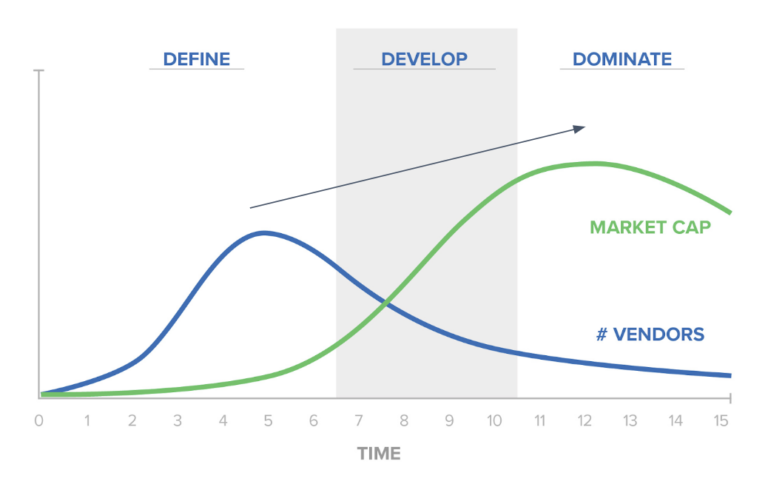
Geroski’s model of new market evolution: many vendors experiment early, then the market converges and value accumulates.
The role of entrepreneurs
The role of entrepreneurs is not to predict the winning trajectory with certainty.
It is to observe these competing directions, experiment continuously, understand how customer demand is evolving, and recognize the signals of an emerging dominant design.
Radical technologies do not simply improve existing products.
They create new technological trajectories, reshape existing markets, and open the door to entirely new categories.
Where we are with AI
We are still in the period of inchoate demand for AI.
LLMs have already emerged as a dominant technological design.
But the dominant design for how AI systems will be built, organized, and integrated into everyday work has not emerged yet.
And that is where the next major breakthrough will come from.

With tools and technology we already have, we can build much more valuable systems than most projects today. We can write software that is a pleasure to use and a pleasure to work on; software that doesn't box us in as it grows, but creates new opportunities and continues to add value for its owners.