Spektrum SDK: Turning Any Platform Into a Vibe Coding Platform
For the last decade, software platforms were mostly places where users managed data, configured workflows, and interacted with predefined interfaces.
The next generation of platforms will be different.
They will not only let users use software. They will let users generate software inside the product itself.
That is the idea behind Spektrum SDK.
Spektrum is infrastructure for generative applications. It allows any product, SaaS platform, internal tool, marketplace, CRM, CMS, education platform, or developer platform to add vibe coding capabilities without building an entire AI coding system from scratch.
With Spektrum, your product can generate complete applications from a single HTTP request and integrate the result directly into your own user experience.
In other words:
Your platform becomes a vibe coding platform.
The Shift: From Static Software to Generative Software
Most products today are static.
A user opens a dashboard, fills forms, changes settings, exports reports, or configures templates. The platform decides what is possible in advance, and the user works inside those boundaries.
Vibe coding changes that model.
Instead of only using predefined features, users can describe what they want to build:
Create a landing page for my new product.
Generate a customer portal for this account.
Build an internal dashboard for these metrics.
Create a small React app that visualizes this dataset.
Generate a microsite for this campaign.
The platform no longer needs to provide every possible interface upfront. It can generate new interfaces, applications, and workflows on demand.
That is a major shift.
But building this capability is hard.
To make it work, a platform needs coding agents, state management, project orchestration, file generation, dependency handling, deployment infrastructure, logs, monitoring, error handling, and a way to return the final application back into the product.
Spektrum packages that complexity behind a simple SDK and API.
What Spektrum Does
Spektrum SDK allows developers to generate and deploy applications programmatically.
At the highest level, the flow is simple:
- Your platform creates a project.
- Your platform sends a task describing what should be built.
- Spektrum runs cloud coding agents.
- The agents generate the application.
- Spektrum builds and deploys it.
- Your platform receives a live application URL.
- You embed, display, or connect that generated app inside your own product.
The result is not just text, code snippets, or a prototype.
The result is a running application.
That is what makes Spektrum different.
It is not another chat interface. It is not just a code generation helper. It is an application generation layer that other products can integrate directly.
One HTTP Request, One Generated Application
The core idea behind Spektrum is extremely powerful:
A single request can become a deployed application.
Your product sends a task like:
Create a finance dashboard with portfolio charts and live ticker.
Spektrum takes that intent and turns it into a working application.
Behind the scenes, Spektrum handles the hard parts:
- project creation
- task execution
- AI coding
- file generation
- build process
- deployment
- application hosting
- status tracking
- logs and monitoring
- final URL generation
From your platform's perspective, the integration can be as simple as calling an API, waiting for the task to complete, and using the returned application URL.
That means any existing product can add generative app creation without rebuilding its architecture around AI agents.
Why This Matters for Platforms
Every platform eventually hits the same limitation:
Users want more flexibility than the product team can build manually.
A CRM user wants a custom client portal.
A marketing platform user wants campaign microsites.
An education platform wants interactive learning apps.
An analytics product wants custom dashboards.
A marketplace wants seller storefronts.
An internal tool platform wants generated admin panels.
Traditionally, each of these features would require product planning, engineering work, frontend implementation, backend support, deployment, and maintenance.
With Spektrum, the platform can generate these experiences dynamically.
This gives product teams a new architecture:
Instead of building every feature manually, they can expose a generative layer inside their product.
The platform provides the context.
Spektrum builds the application.
The user gets a custom experience.
Your Product Stays the Product
One of the most important parts of Spektrum is that it does not try to replace your platform.
It works behind the scenes.
Your users do not need to know that Spektrum exists. They stay inside your product, use your interface, and experience the generated application as part of your platform.
Spektrum becomes the infrastructure layer.
Your product owns the user experience.
This is important because most companies do not want to redirect users to another tool. They want to make their own product more powerful.
Spektrum enables exactly that.
You can use it to add a “Generate App” button, create AI-powered project builders, generate custom dashboards, produce landing pages, build internal tools, or create dynamic user-facing experiences directly from your platform.
The generated application can be embedded inside your product, opened as a public link, attached to a project, connected to a user account, or used as a generated artifact inside your workflow.
Integration Flow
You can try it today on the JigJoy platform with $5 in free credits. Sign up, generate an API key, and run your first SDK task in minutes. Credits are deducted based on task complexity once your agents finish building.
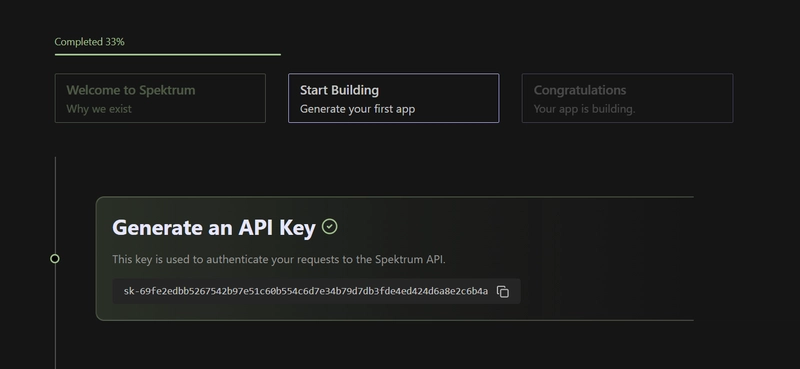
A typical Spektrum integration looks like this:
import { SpektrumSDK } from "@spektrum-ai/sdk"
const spektrum = new SpektrumSDK()
const project = await spektrum.createProject("finance-dashboard")
const task = await spektrum.createTask(  project.id,  "Create a finance dashboard with portfolio charts and live ticker")
await spektrum.codeAndDeploy(task)
const appUrl = await spektrum.getAppUrl(project.id)
console.log(`Live at: ${appUrl}`)
While agents work, you can follow everything on the JigJoy monitoring platform. Track tasks, read agent comments, and watch the application get built step by step — from planning and coding through build and deployment. Leave comments to re-run a task when you want changes.
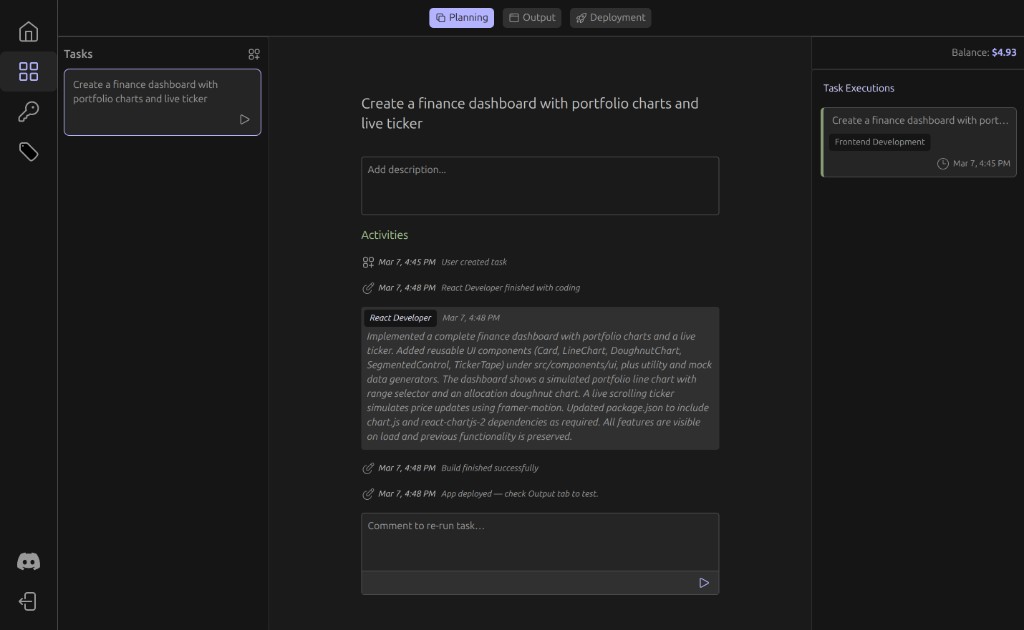
When agents finish building, Spektrum deploys the application to the cloud. Developers receive a live URL — for example, https://78bcd287-5719-4aa7-b9f8-e3ca4ec37f43.apps.jigjoy.ai/ — that they can open in a new tab or embed directly inside their own product through an iframe.
This is the core value of Spektrum.
The developer does not need to manually create a coding agent system.
The developer does not need to manage file state.
The developer does not need to build deployment infrastructure.
The developer does not need to design a complete app-generation pipeline.
Spektrum abstracts that away.
The platform only needs to provide the task and decide how to use the generated application once it is ready.
The Full Process Behind the Scenes
Although the SDK experience is simple, the process behind Spektrum is highly technical.
When a platform sends a generation request, Spektrum creates an isolated project environment. This environment becomes the workspace where AI coding agents can reason, generate files, update the application, and prepare it for deployment.
The task is then passed to cloud coding agents.
These agents interpret the user's intent, generate the application structure, write the necessary code, and prepare the project for execution. The agents are not simply returning a text answer. They are working inside an application-generation pipeline.
Once the code is produced, Spektrum handles the build and deployment process.
This includes preparing the app, resolving the generated project, deploying it, and exposing it through a live URL.
Finally, the platform receives the generated application URL and can decide how to present it.
It can embed the app in an iframe.
It can attach it to a user project.
It can show it as a preview.
It can publish it as a standalone page.
It can use it as part of a larger workflow.
This creates a clean separation of responsibilities:
Your product owns the business context and user experience.
Spektrum owns the AI app generation infrastructure.
Why Spektrum Is Special
Spektrum is special because it turns vibe coding into infrastructure.
Most vibe coding tools are standalone products. A user visits the tool, writes a prompt, generates an app, and works inside that specific environment.
Spektrum takes the opposite approach.
It makes vibe coding embeddable.
That means other platforms can become generative without having to build the entire stack themselves.
This is similar to what Stripe did for payments or what Twilio did for communications.
Stripe made payments programmable.
Twilio made messaging programmable.
Spektrum makes application generation programmable.
That is the category shift.
Instead of asking users to leave your product and use a vibe coding tool somewhere else, Spektrum lets your product become the place where software is generated.
From Feature Requests to Generated Features
One of the most powerful use cases for Spektrum is turning user intent directly into software.
Today, when users ask for custom functionality, product teams usually have three options:
- Say no.
- Add the request to the backlog.
- Build a generic version for everyone.
Spektrum introduces a fourth option:
Generate a custom application for that specific user, context, or workflow.
This changes how platforms can think about extensibility.
Not every user need has to become a core product feature.
Some needs can become generated applications.
This gives platforms more flexibility, faster experimentation, and a much better way to serve long-tail user requirements.
Use Cases
Spektrum can be used across many kinds of products.
A CRM can generate client portals, account dashboards, lead qualification tools, or sales microsites.
A marketing platform can generate landing pages, campaign dashboards, calculators, or branded microsites.
An education platform can generate interactive lessons, quizzes, simulations, or student projects.
A data platform can generate dashboards, visualizations, and internal reporting apps.
A marketplace can generate seller storefronts, buyer experiences, and product-specific pages.
A developer platform can generate examples, demos, starter apps, or custom integration UIs.
An internal tool platform can generate admin panels, operational dashboards, and workflow-specific applications.
In each case, the core pattern is the same:
The host platform owns the context.
Spektrum generates the application.
The user gets a custom software experience.
Why Single-Request App Generation Matters
The most important technical abstraction in Spektrum is not only that it uses AI.
The important part is that it compresses the entire application creation lifecycle into a programmable request.
Normally, building an application requires multiple steps:
- interpret requirements
- design the UI
- create the project
- write code
- manage files
- install dependencies
- run builds
- fix errors
- deploy the app
- expose the result
- integrate it back into the product
Spektrum turns this into an API-level capability.
That is what makes it powerful for other platforms.
It is not just helping developers code faster.
It is making software generation available as infrastructure.
Built for Developers
Spektrum is designed as developer infrastructure.
The SDK gives developers a simple way to create projects, submit tasks, run generation, deploy applications, and retrieve live URLs.
The API-first model makes it easy to integrate Spektrum into existing products.
You can start with a simple button.
Then you can add status updates.
Then previews.
Then project history.
Then user-specific generation flows.
Then deeper integration into your own platform data.
Spektrum does not force one product pattern.
It gives developers the core capability: generate and deploy applications from code.
What developers build around that is up to them.
The Bigger Vision
The future of software is not only AI assistants helping developers write code.
The future is software that can generate more software.
Every serious platform will need some form of generative capability.
Users will expect products to adapt to their intent, not only offer predefined menus and static screens.
Spektrum is built for that future.
It gives platforms the infrastructure to generate applications on demand, deploy them automatically, and integrate them directly into existing product experiences.
That is why Spektrum is more than an SDK.
It is a generative application layer.
It turns vibe coding from a standalone destination into an embedded capability.
And it gives any platform the ability to become a vibe coding platform.
Integration guidelines are available on GitHub:
github.com/jigjoy-ai/spektrum-sdkLearn more about Spektrum:
jigjoy.ai/spektrum
With tools and technology we already have, we can build much more valuable systems than most projects today. We can write software that is a pleasure to use and a pleasure to work on; software that doesn't box us in as it grows, but creates new opportunities and continues to add value for its owners.