The Language We Taught Machines
This is one of my earliest memories. Maybe my very first.
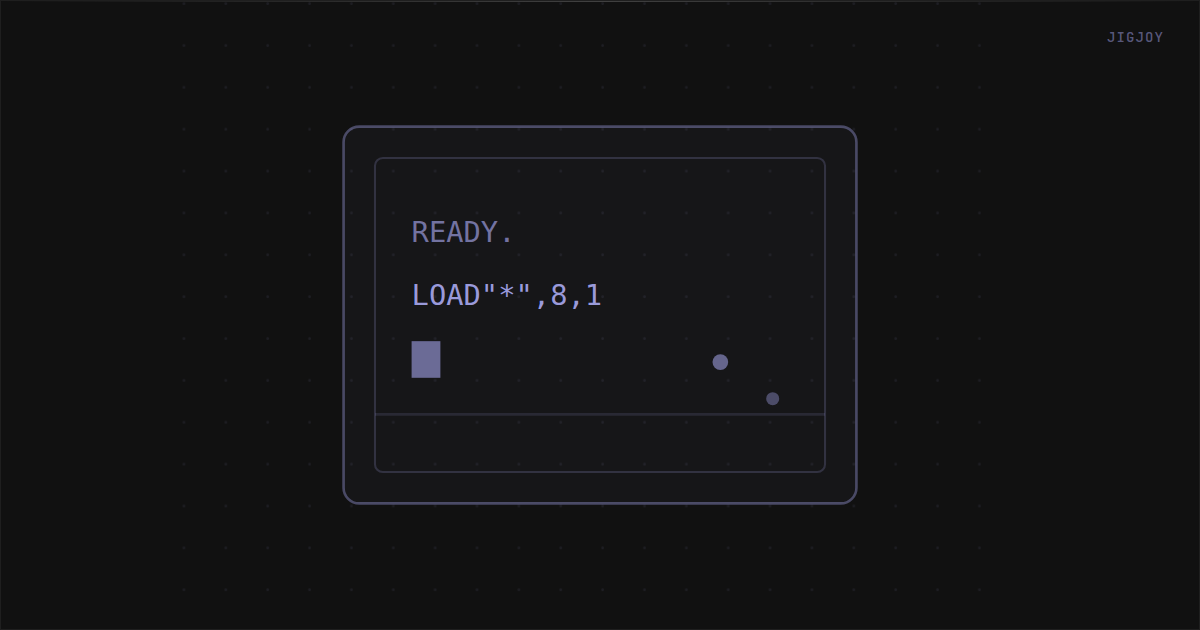
My father sits in front of a Commodore 64. He types LOAD "*",8,1 and presses enter.
Then — music. Colors. The intro comes to life.
I was a child. I didn't know what had happened, I didn't know what the command meant, I didn't know that decades of someone's work stood behind it. I knew only one thing: it was magic. My father had said something to a machine, and the machine had answered.
It took me many years to understand how extraordinary that scene really was.
Who taught whom
For a machine to speak our language, someone first had to spend years speaking its.
That is the paradox that carries the whole story of computing. Nameless people thought in bits, in processor cycles, in memory addresses — they learned the machine's foreign language perfectly, only so that they could, in the end, translate it back into ours. They had to become more machine-like in order to make it more human.
And it didn't happen all at once. Assembly hid machine code. C hid assembly. The graphical interface hid the command line. Each of those layers was an act of faith — faith that it's all right to hide complexity, that the user doesn't have to know everything. And every time, someone said: this is how we lose control, precision, understanding.
They were right. And at the same time, they were missing the point.
Because the goal was never for everyone to understand the machine. The goal was for the machine to stop being an obstacle between a person and what they want. My father didn't want to program. He wanted to see that intro. The command was just the price of admission.
That language took us far
That communication — crude as it was — took us to the Moon. The Apollo Guidance Computer had four kilobytes of memory, and the astronauts talked to it by typing numeric codes into the vacuum, 384,000 kilometers from home. They didn't wait for the perfect interface. They went with what they had, and with an enormous amount of trust in the machine.
And then something happened that the generations before us never lived to see: the machine began to answer in a sentence. Not in a command, not in syntax. In a thought. Sometimes in something that resembles understanding.
The borders that for decades stood firm — machine language here, human language there — are slowly dissolving. Or maybe they aren't dissolving so much as giving birth to a third thing: a language that is neither fully machine nor fully human.
And here is the part that moves me most. We changed the machines, and they changed us. When I phrase a question for a machine, I unconsciously think more clearly than I would if I were saying it to a friend — I have to be explicit, to surface the context, to name the intent. That new language I'm learning to speak with it begins to shape how I think at all. Because language was never just a tool for communicating. Language shapes thought.
What surprises me
Today all of this has become air. Invisible. We talk to machines every day and most people take it for granted — some even with contempt, while asking those same machines how to use them.
I understand where that comes from. Every great leap carried fear, from the printing press to television. But there is a difference between healthy caution, which asks what we are losing, and reflexive rejection, which asks nothing.
I believe in something else. I believe that now, as always, out of the millions who use these tools on the surface, a few will be caught by the same fascination that caught me in front of the C64. The ones who will want to dig deeper, through all those layers, all the way down. And their pool is deeper now than it has ever been — they don't have to start from machine code, they can start from intent and dig backward as far as they like.
They will make the next breakthrough. The way it has always been made — by the ones who were first made to wonder.
The circle
I have to admit one thing. Everything above came out of a single conversation — with a machine. I asked it whether the way we talk to machines has changed, and so, word by word, we arrived at my father and the Commodore 64.
A conversation with a machine returned to me the memory of my first conversation with a machine.
My father didn't teach me programming. He taught me wonder. Everything else came on its own.
And it strikes me only now: my earliest memory is a conversation with a machine. So, it turns out, is most of what came after.
LOAD "*",8,1