Why Agent Frameworks End Up As SDK Wrappers — And How To Overcome It
Today, most frameworks for building AI agents are missing something fundamental. If you look closely at the language they use, you'll notice a pattern: their domain models are anemic. They give you abstractions like "agent", "tool", "step", but they don't actually model the thing that matters most - context. Because of that, developers are left on their own to deal with problems like:
- context window overflow
- context bloating
- loss of structure across multiple model calls
- messy handling of tool outputs and reasoning
And where does all of that logic end up? In your application layer.
The Hidden Cost: Polluting Your Domain
Instead of focusing on your actual domain (finance, healthcare, internal tooling, etc.), you start writing code like:
- guessing what the model "needs to see" next
- use your own way and schema to persist context
- load context with schema which is not most efficient way to do it
- and so on...
This is not your domain. It's not even context engineering. In the absence of the right abstractions, developers are pushed to reimplement core LLM concepts themselves—while mixing them with their own domain logic. And this is where complexity arises. We experienced these issues firsthand. That’s what pushed us to address them—so engineers like us can extract more from LLMs and open up new possibilities.
The goal with Mozaik is simple:
Enable developers to use a rich domain model for handling context in agentic applications.
So instead of letting LLM concerns leak into your domain, you can:
- keep your domain logic isolated and aligned with best practices
- use standardized building blocks to build your own context model
- don't spend time reinventing the wheel
- and hopefully, enjoy the process
At the same time, this is a space we're actively learning in. LLMs are still evolving, and we want to both learn and share what we discover while working on these problems.
Starting Point: OpenResponses
We didn't start from scratch.
Our starting point is the OpenResponses specification, published by companies like OpenAI, OpenRouter, Vercel and others in January this year. Their goal is to standardize how we work with LLM providers. They define a shared structure that reflects how models actually operate.
At its core:
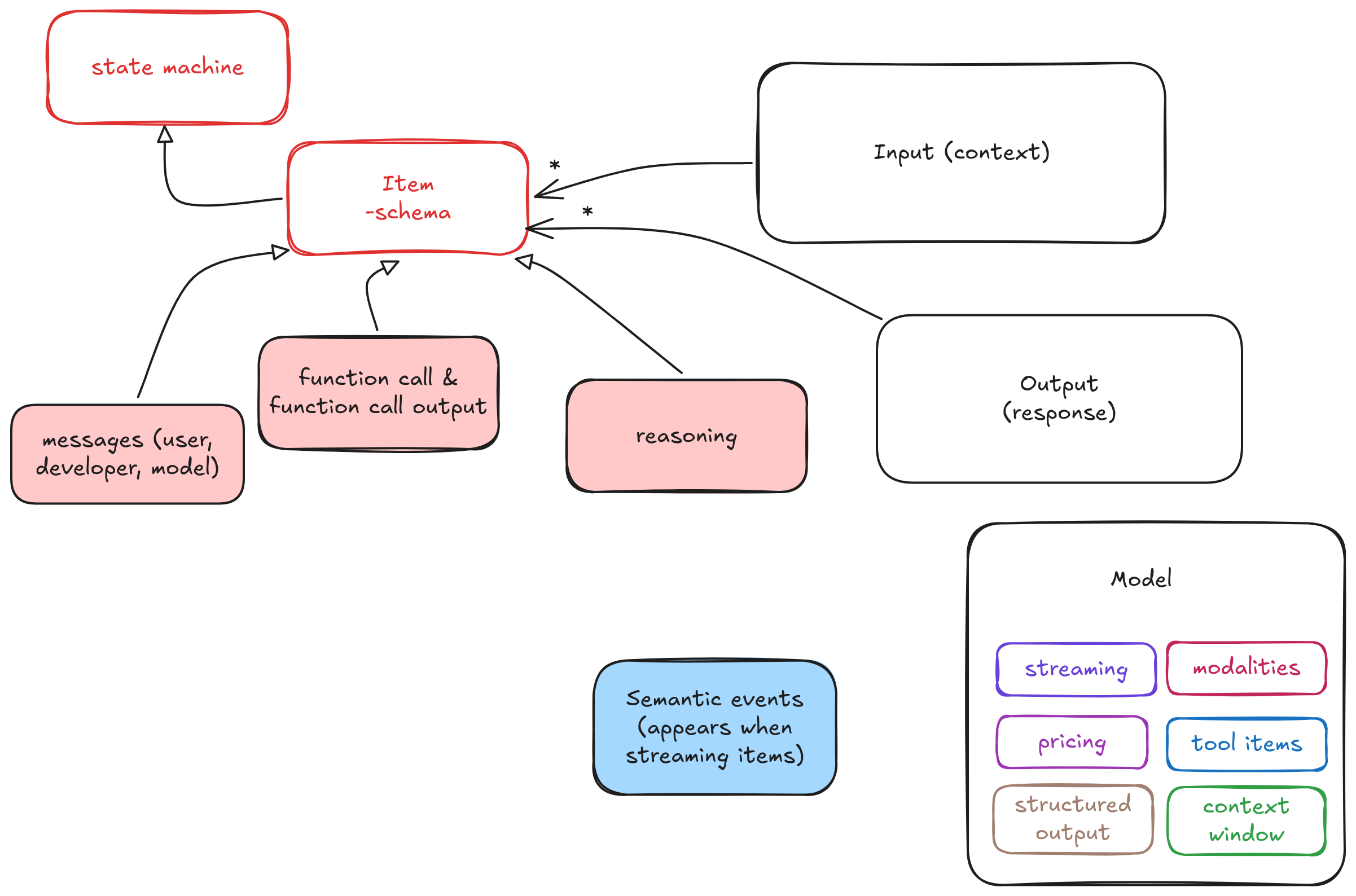
Context is composed of context items.
These include:
Client-created items
- user message
- developer message
- function call output
Model-generated items
- reasoning
- function call
- model message
They also introduce an important idea:
Model-generated items are state machines that can be streamed with semantic events.
Those are the fundamental building blocks of the OpenResponses specification and how major LLM providers implement them. For a deeper dive, you can check: https://www.openresponses.org/
Our Take on This
OpenResponses gives us the source of truth for how LLMs work today. These building blocks should not be ignored. But the specification itself is not enough. Developers still need a way to work with it in practice.
Enter Mozaik
Our approach is to take this specification and turn it into a rich object domain model. The goal is not to abstract everything away, but to:
- make context explicit
- make it composable
- make it persistent
- make it evolvable across multiple steps
With our base implementation, developers can:
- build structured context from typed items
- manage model-generated items (reasoning, function calls, outputs)
- persist context
- restore it and continue execution
All without leaking context engineering concerns into their core domain logic.
Where This Leads
We see this as a starting point.
By introducing a richer domain model for context, new opportunities open up:
- better strategies for context compression
- smarter handling of long-running interactions
- clearer debugging and observability
- more predictable and controllable multi-agent systems
Basic Example
Here's a minimal example of building and storing context using Mozaik:
const contextRepository = new InMemoryContextRepository()
const message = UserMessage.create("Tell me a joke about birds")const developerMessage = DeveloperMessage.create(  "You are a joke teller. You will be given a joke and you will need to tell it to the user.",)
const projectId = `pr-${crypto.randomUUID()}`
const context = Context.create(projectId)  .addItem(developerMessage)  .addItem(message)
await contextRepository.save(context)
const model = new GPT54Model()const generatedItems = await model.call(context)context.addItems(generatedItems)await contextRepository.save(context)
const restoredContexts = await contextRepository.getByProjectId(projectId)console.log(restoredContexts)
This uses an in-memory repository, but in real applications you can plug in your own persistence layer.
You can find more working examples in the GitHub repository:
github.com/jigjoy-ai/mozaik-examplesFinal Thought
The industry is moving fast. But if we keep ignoring context as a core primitive, we'll keep rebuilding the same fragile systems. Mozaik is our attempt to fix that — by giving context the place it actually deserves. And this is just the beginning. We're excited to see where this journey takes us.

When complexity gets out of hand, the software can no longer be understood well enough to be easily changed or extended. By contrast, a good design can make opportunities out of those complex features.