ClaimScope
What it does
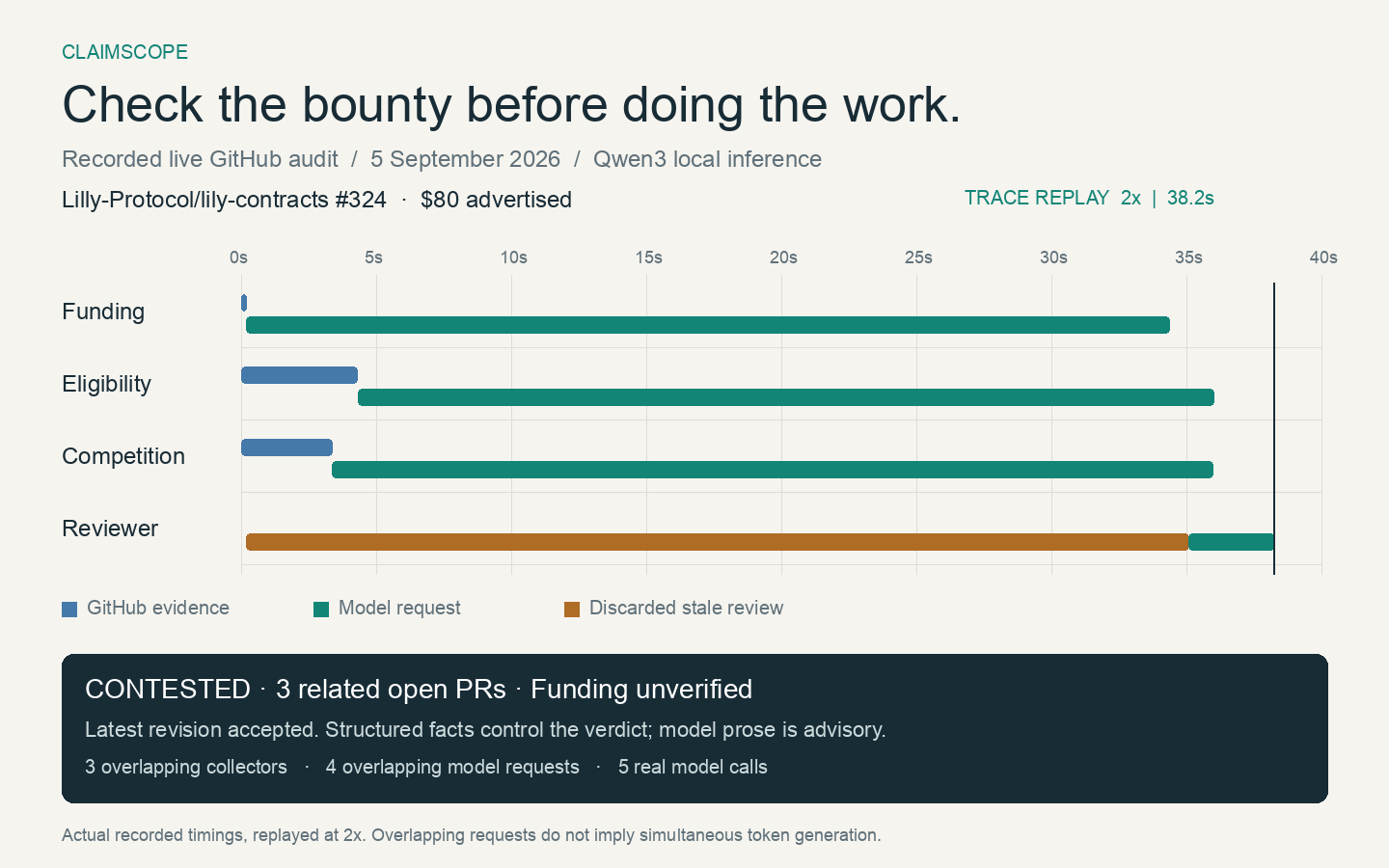
ClaimScope checks a public GitHub bounty before someone invests time in it. Three evidence agents investigate advertised funding, contribution rules and repository status, and related pull requests. A fourth reviewer starts with partial evidence and discards its answer if newer facts arrive. Typed facts determine the assessment; model commentary remains advisory. The recorded live audit found three related open PRs on an advertised $80 task and kept payment unverified. Built this weekend with Codex assistance, Mozaik 4.0.5, TypeScript and locally hosted Qwen3-4B. Five tests and typecheck pass. The repository includes runnable setup, a 25-second trace replay, raw event timings, sources and documented model limitations.
How the agents run concurrently
One audit.started semantic event fans out to three independent createAgent situation processors. They launch their GitHub collectors without awaiting each other, publish audit.evidence into shared RuntimeState, increment its revision, and start their own Mozaik runLoop. A fourth agent reacts to the first evidence while the other collectors and inference requests continue. When the reviewer finishes, it compares its input revision against the current shared revision: stale reviews are logged and discarded, then a fresh loop starts; intermediate revisions are coalesced while it is busy. Completion requires all three workers and a review of the latest evidence. The real 38.248-second run recorded three overlapping collectors, four overlapping model requests and five model calls. The revision-1 review was discarded; revision 3 was accepted. The video replays actual timestamps at 2x speed, with no invented events. Tests use a barrier to prove collector overlap and deliberately delayed evidence to verify stale-review replacement. Overlapping requests do not imply simultaneous token generation in the local server.